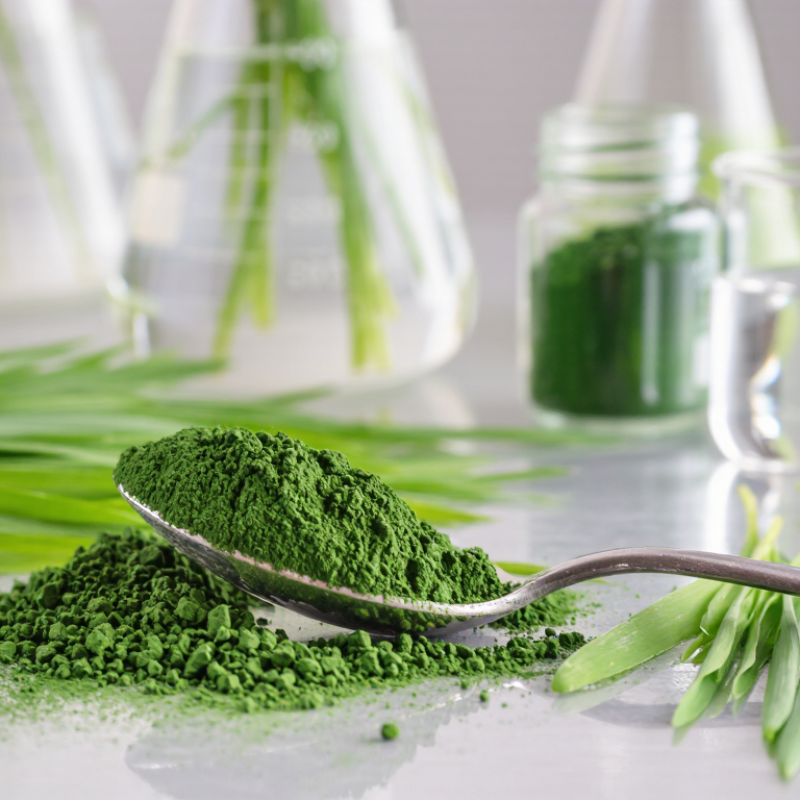
| 1 | Confirm the raw-material identity | The material should be identified as juice powder made from young barley grass, botanically classified as Hordeum vulgare. The specification should state whether the product is whole-plant powder, juice powder, or an extract. | Review the botanical name, plant part, harvest stage, processing flow, country of origin, and product description on the specification and certificate of analysis. | Clear identity documentation with no ambiguous terms such as “green superfood blend” used in place of the actual ingredient name. |
| 2 | Define the juice-processing method | Require a documented sequence covering washing, juice separation, concentration if used, drying, milling, and packaging. Spray drying is common, but the carrier should be declared because it can affect the ingredient’s composition and labeling. | Request the process flow diagram, carrier statement, drying temperature range, moisture-control procedure, and allergen cross-contact controls. | The supplier can explain processing controls and provides consistent information across the specification, label declaration, and batch records. |
| 3 | Set measurable quality parameters | Establish limits for appearance, color, odor, taste, particle size, moisture, water activity, solubility or dispersibility, and bulk density. The exact limits should be agreed for the intended application rather than copied from a generic product sheet. | Compare representative pre-shipment samples with the approved master sample and test moisture and water activity using validated laboratory methods. | A complete specification includes numerical limits, sampling procedures, test methods, and defined actions for out-of-specification batches. |
| 4 | Verify microbiological safety | The finished powder should be tested for total aerobic microorganisms, yeast and mold, coliforms or Escherichia coli, and pathogens such as Salmonella. Destination-market requirements should determine the final acceptance limits. | Check batch-specific laboratory results and the analytical methods, such as ISO 4833-1 for aerobic colony count, ISO 21527 for yeast and mold where applicable, ISO 6579-1 for Salmonella, or equivalent validated methods. | Results are linked to the lot number, show units and detection limits, and are issued by a competent internal or independent laboratory. |
| 5 | Screen contaminants and agricultural residues | The risk assessment should cover heavy metals, pesticide residues, mycotoxins where relevant, foreign matter, and unauthorized substances. Limits must follow the regulations of the target market. | Request multi-residue pesticide testing by LC-MS/MS and GC-MS/MS where appropriate, heavy-metal testing by ICP-MS or ICP-OES, and a documented contaminant-risk assessment. | Testing covers the actual growing region and crop season, not only a generic annual report or an undated declaration of compliance. |
| 6 | Evaluate traceability and food-safety systems | Each lot should be traceable from farm or approved raw-material source through processing, packaging, storage, and shipment. A preventive food-safety plan should address biological, chemical, and physical hazards. | Review the lot-code system, recall procedure, supplier-approval program, sanitation records, internal audits, and current third-party food-safety certification if available. | The supplier can complete a trace-back exercise and provide controlled records without relying solely on marketing claims. |
| 7 | Test commercial fit before placing a large order | Assess sample performance in the final application, including flavor, color, sedimentation, dispersibility, processing stability, packaging compatibility, shelf life, minimum order quantity, lead time, and storage conditions. | Conduct a documented pilot trial using at least one representative lot and compare results against the approved product specification and finished-product requirements. | The supplier supports sample retention, change notification, shelf-life data, packaging validation, and a written corrective-action process. |







 System Features
 Key Features
 Key Features
 Key Features
 Key Features
 Key Features
 Key Features
 Key Features
 Key Features
 Key Features