| Compressed Non-Asbestos Fiber | Compressible fiber and elastomer matrix fill surface irregularities between bolted flanges. | Approximately -40 to 350°C, depending on grade and binder. | Suitable for low-to-medium pressure service; confirm the manufacturer’s pressure-temperature chart. | Water, air, oils, fuels, and selected chemicals; compatibility varies significantly by binder. | Pipe flanges, pumps, compressors, water systems, and general industrial equipment. | Fiber type, binder, thickness recovery, blowout resistance, and relevant flange standard. |
| Expanded PTFE | Soft, chemically resistant PTFE conforms to flange imperfections under compression. | Approximately -200 to 260°C for many grades. | Low-to-medium pressure service; pressure depends on density, thickness, and flange loading. | Broad chemical resistance, including many acids, bases, solvents, and process fluids. | Chemical processing, pharmaceutical equipment, food-processing systems, and fragile flanges. | Chemical compatibility, creep resistance, food-contact requirements, thickness, and cleanability. |
| Graphite Sheet | Layered graphite compresses and adapts to uneven surfaces while maintaining sealing under heat. | Approximately -200 to 450°C in oxidizing service; higher temperatures may be possible in non-oxidizing conditions. | Medium-to-high pressure service when correctly specified and installed. | Steam, hydrocarbons, oils, and many chemical media; oxidizing environments require special evaluation. | Steam lines, thermal equipment, valves, heat exchangers, and high-temperature piping. | Oxidation resistance, filler or reinforcement, density, handling strength, and operating atmosphere. |
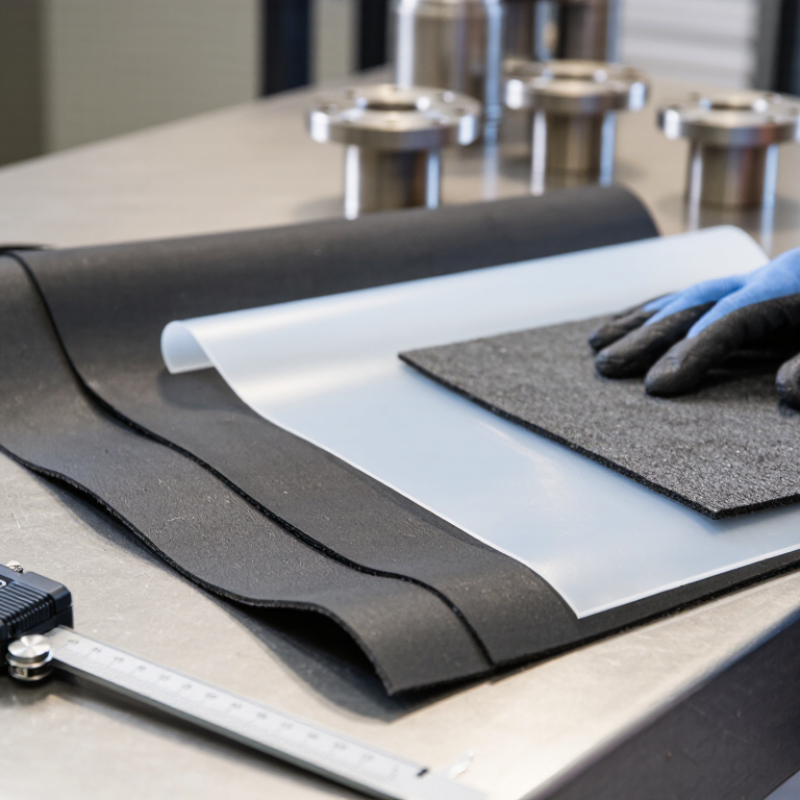
| Rubber Sheet | Elastic material creates contact pressure and compensates for minor movement or surface irregularities. | Commonly about -40 to 120°C, depending on rubber family. | Generally low-to-medium pressure; use only within the specified temperature and compression limits. | Water, air, oils, fuels, or chemicals depending on EPDM, NBR, silicone, FKM, or other formulation. | Covers, tanks, sanitary equipment, low-pressure flanges, and enclosure seals. | Rubber polymer, hardness, elongation, compression set, media compatibility, and aging resistance. |
| Metal-Jacketed Mat | A soft filler is enclosed by a metal jacket, combining conformability with mechanical protection. | Often suitable for approximately -200 to 500°C, subject to metal and filler selection. | Medium-to-high pressure service with adequate bolt load and flange alignment. | Steam, gases, oils, fuels, and process chemicals; jacket material must match the fluid. | Heat exchangers, pressure vessels, exhaust systems, and high-temperature flanges. | Jacket metal, filler type, dimensions, weld quality, handling damage, and minimum seating stress. |
| Spiral-Wound Mat | Alternating metal winding and soft filler form a resilient seal that tolerates thermal cycling. | Commonly used from cryogenic conditions to approximately 500°C, depending on materials. | Medium-to-high pressure service; design class, winding density, and inner or outer rings are important. | Steam, hydrocarbons, gases, and many process fluids when winding and filler are correctly selected. | Refineries, chemical plants, power generation, pipelines, and pressure equipment. | Winding material, filler, centering ring, dimensions, pressure class, and required bolt load. |
| Metal Ring Mat | A precisely machined metal ring seals by controlled plastic deformation or line contact in a machined groove. | Often suitable for approximately -200 to 600°C or more, depending on alloy and service. | High-pressure and high-temperature applications when the groove and ring are correctly matched. | High-pressure gas, oil, steam, and aggressive process fluids; alloy selection is critical. | Oil and gas equipment, pressure vessels, high-pressure valves, and critical piping joints. | Ring geometry, material hardness, surface finish, groove dimensions, traceability, and nondestructive testing. |






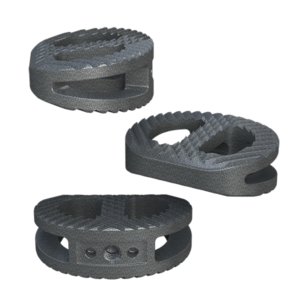 System Features
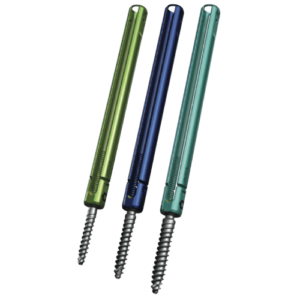 Key Features
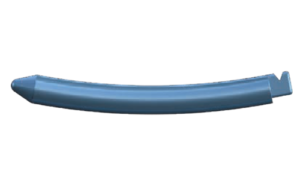 Key Features
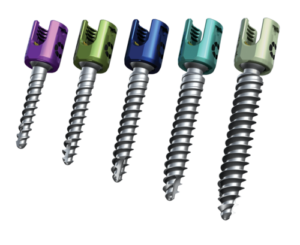 Key Features
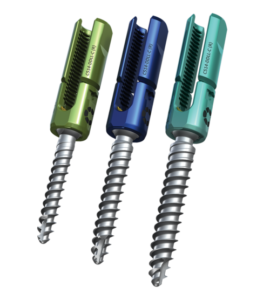 Key Features
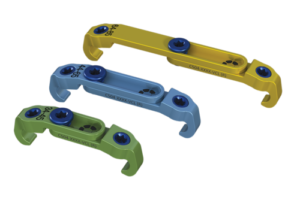 Key Features
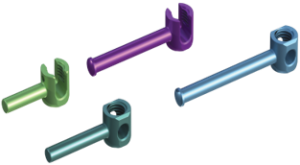 Key Features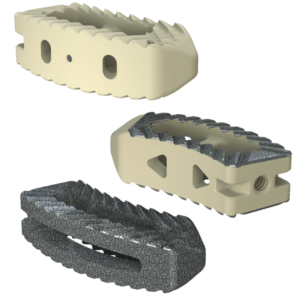
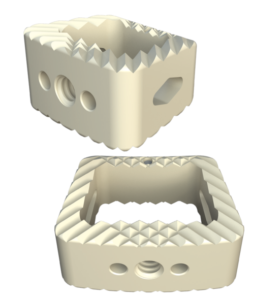 Key Features
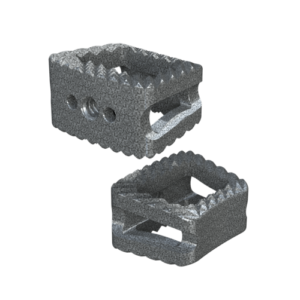 Key Features
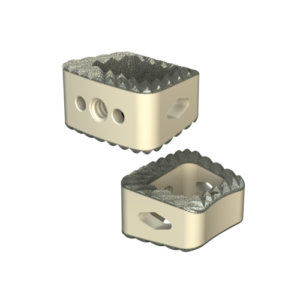 Key Features