FUE
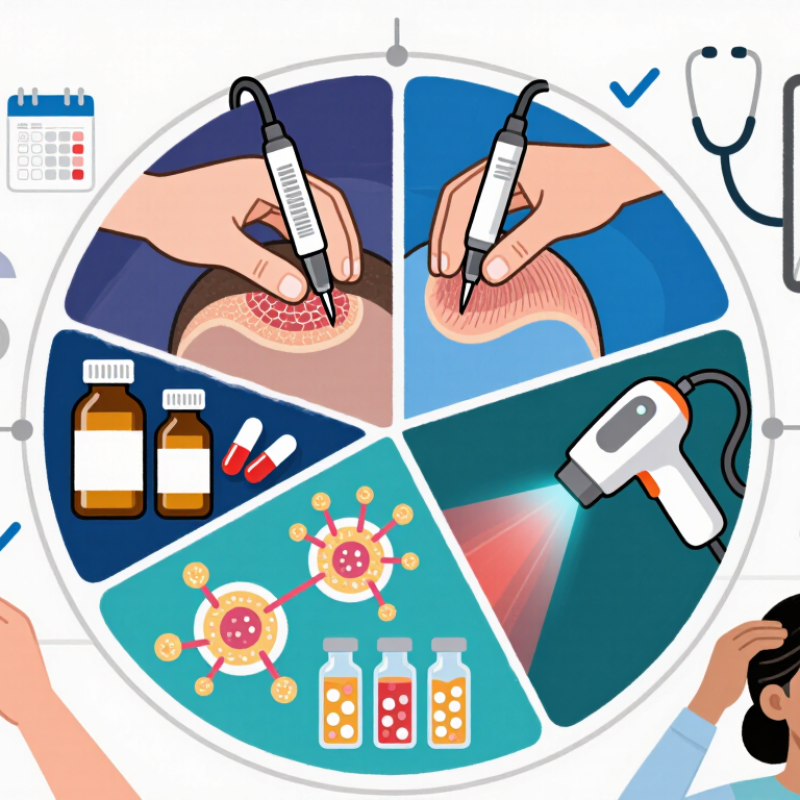
(Follicular Unit Excision) | Individual follicular units are removed from a donor area and placed into recipient sites. | Often about 1,000–3,000 grafts in one session; larger sessions depend on donor density, treatment time, and medical assessment. | Small crusts and redness commonly last about 7–14 days. Temporary shedding may occur several weeks after surgery. | Many small, round scars that are usually less noticeable than a linear scar when performed properly. | People seeking a linear-scar-free approach, including some short-hairstyle wearers with adequate donor supply. | Can overharvest the donor area; may take longer than strip surgery for large cases; results depend strongly on extraction and implantation technique. | ★★★★★ |
FUT
(Follicular Unit Transplantation) | A strip of hair-bearing skin is removed from the donor area, and follicular units are dissected for transplantation. | Commonly suitable for approximately 1,500–4,000 grafts, depending on scalp laxity and donor characteristics. | Incision healing generally takes around 10–14 days; soreness or tightness can persist longer in some patients. | Leaves a linear donor scar, which may be concealed by surrounding hair but can be visible with very short cuts. | People who may need a larger number of grafts and are comfortable maintaining enough donor-hair length to cover the scar. | Linear scarring, possible scalp tightness, and a longer incision-healing period than uncomplicated FUE. | ★★★★☆ |
DHI
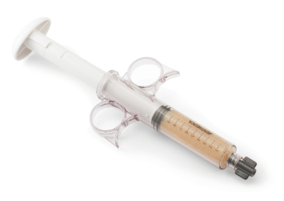
(Direct Hair Implantation) | Usually refers to implantation of individually harvested grafts with an implanter device; it is generally a variation of FUE rather than a separate donor-harvesting method. | Frequently used for smaller or moderate sessions; capacity varies with graft quality, team skill, and operating time. | Often similar to FUE because graft harvesting still commonly uses an extraction technique; redness and crusting may last about 7–14 days. | Usually reflects the scarring pattern of the chosen extraction method, most often multiple small FUE scars. | Selected cases requiring detailed control of implant angle, direction, or density, after professional assessment. | The device does not guarantee better growth; it may increase procedure time and cost, and terminology is not standardized worldwide. | ★★★★☆ |
| Robotic-Assisted FUE | A computer-assisted system helps identify and extract selected follicular units; implantation is usually completed manually. | Varies by system, hair characteristics, and clinic protocol; it is generally used for selected FUE cases rather than every patient. | Comparable to FUE when extraction and aftercare are uncomplicated. | Multiple small extraction scars, similar to conventional FUE. | People with suitable hair color, curl pattern, donor density, and follicle visibility for the device being used. | Not appropriate for all hair types; availability is limited, and automation does not replace surgical planning or clinical judgment. | ★★★☆☆ |
| Non-Surgical Medical Therapy | May include clinically prescribed medicines or evidence-based light therapy intended to slow loss or support existing follicles; it does not transplant hair. | Not applicable; it preserves or stimulates existing follicles rather than adding donor grafts. | No surgical wound. Benefits generally require consistent, long-term use and periodic review. | No surgical scar. | People with early or ongoing pattern hair loss, especially when follicles remain miniaturized but viable. | Effectiveness varies; some treatments have contraindications or systemic side effects and should be discussed with a qualified clinician. | ★★★★☆ |
| Scalp Micropigmentation | Pigment is placed into the superficial scalp to simulate the appearance of shaved follicles or add visual density. | Not applicable; it creates an optical effect and does not grow hair. | Usually involves mild redness or sensitivity for a short period, with staged sessions often used for color and density adjustment. | Non-surgical; pigment can fade or change over time and may require maintenance. | People wanting the appearance of a closely shaved style or improved visual coverage without surgery. | Cannot restore hair growth; unsuitable pigment choice or poor design can look unnatural and may be difficult to correct. | ★★★☆☆ |
| Hair System or Prosthesis | A custom or ready-made hairpiece is attached with clips, adhesives, or other methods to create immediate coverage. | Not applicable; no follicles are transplanted. | Immediate cosmetic change, but regular fitting, cleaning, replacement, and scalp-care appointments are required. | No surgical scar. | People seeking immediate coverage or those who are not suitable for surgery or prefer a reversible option. | Ongoing maintenance cost, attachment concerns, heat or moisture management, and possible scalp irritation. | ★★★☆☆ |





 System Features
 Key Features
 Key Features
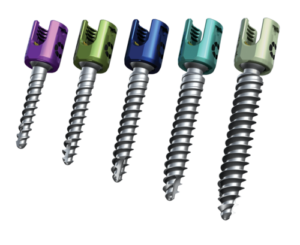 Key Features
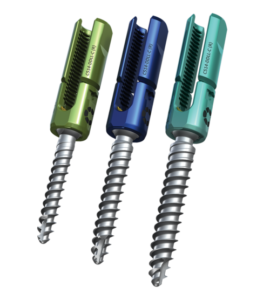 Key Features
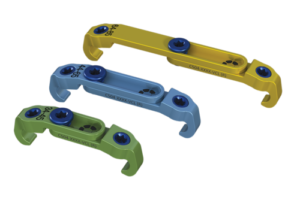 Key Features
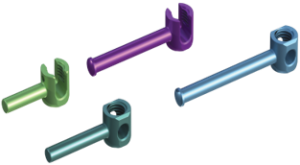 Key Features
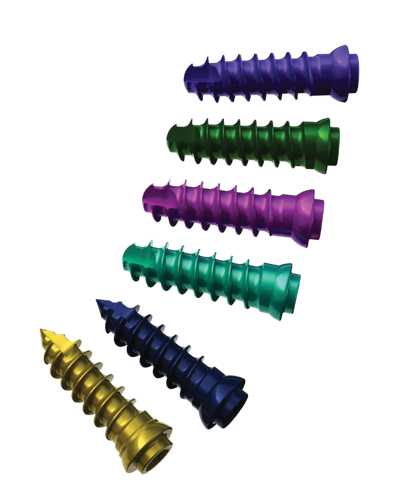
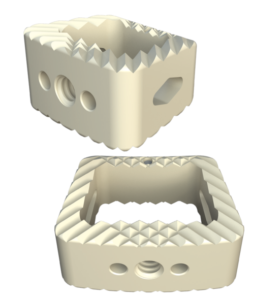 Key Features
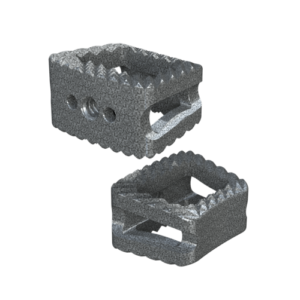 Key Features
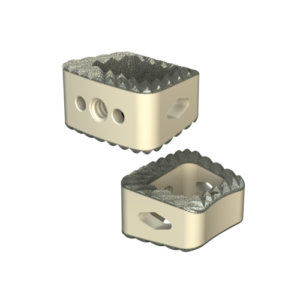 Key Features